
Cascading Cognitive Deficit in Education: How Early Learning Gaps Shape India's School Outcomes
An analysis of Cascading Cognitive Deficit in India’s education system, showing how foundational gaps in concepts like fractions affect long-term learning, based on NAS and PARAKH data and calling for competency-based reforms
For decades, India’s school education system has expanded access, improved enrolment, and strengthened institutional delivery. Classrooms are fuller, textbooks are standardised, and assessments are conducted at scale, from NAS rounds to the more competency-focused PARAKH Rashtriya Sarvekshan. Yet beneath this progress lies a quieter structural challenge, one that does not announce itself in early grades but reveals its consequences sharply in later years. This is the system’s ongoing tryst with Cascading Cognitive Deficit (CCD).
Cascading Cognitive Deficit (CCD) may be understood as a systemic cognitive phenomenon in which failure at an early competency transition point progressively constrains the acquisition of later competencies that are structurally dependent upon it. The central premise of CCD is that learning does not progress as an isolated accumulation of topics but as an interconnected hierarchy of cognitive dependencies where certain concepts reorganise the learner’s capacity for future abstraction and reasoning. Fractions represent one such critical transition point because they mark the learner’s movement from concrete arithmetic to relational and proportional thinking. If this cognitive transition remains unresolved, later competencies such as percentages, ratios, algebra, statistics, and data interpretation do not merely become difficult in isolation; they weaken systematically because the prerequisite conceptual architecture that supports them has never stabilised.
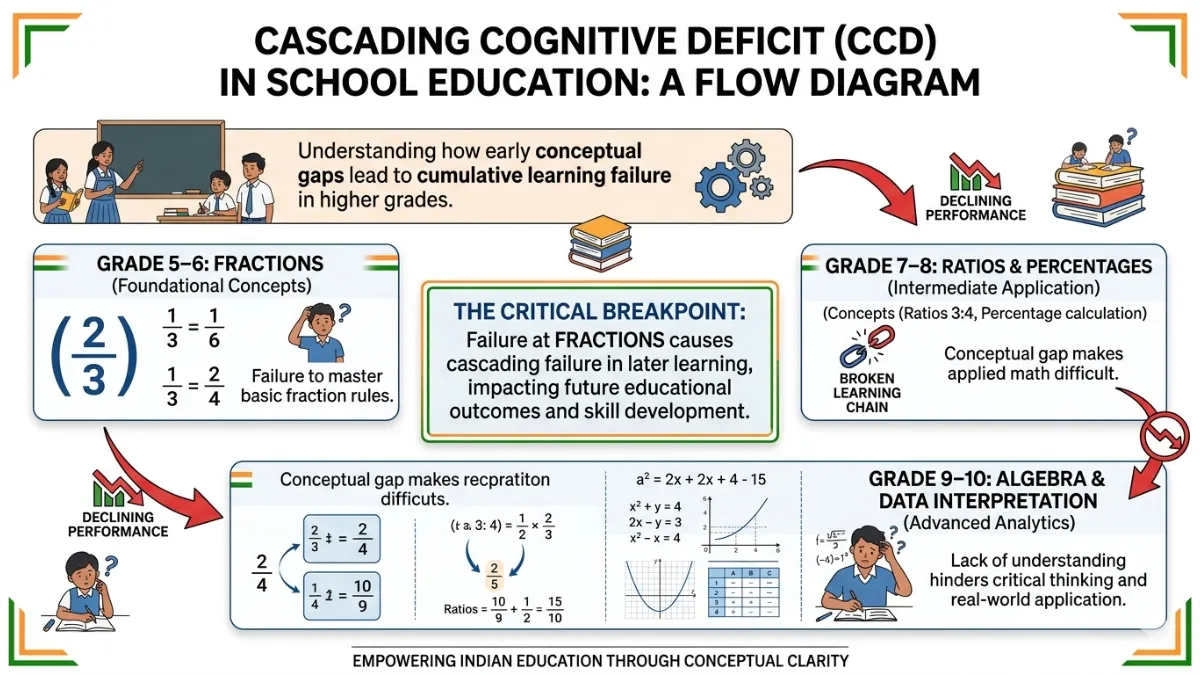
Infographic showing Cascading Cognitive Deficit (CCD): weak understanding of fractions in Grades 5-6 leading to failures in ratios, percentages, algebra, and data interpretation in higher grades
The consequence is a system where learning gaps are not evenly distributed but concentrated at critical cognitive transition points. Once a learner crosses this threshold without adequate conceptual grounding, the deficit compounds. Over time, this leads to reduced confidence, disengagement from subjects like mathematics, and ultimately limited preparedness for higher education and employment.
The evidence for this has existed for years.
NAS 2021 already signalled a troubling pattern in mathematics learning. National average scores declined steadily as students moved to higher grades, from 284 in Class 5 to 255 in Class 8 and further to 220 in Class 10. This was not simply a decline in marks but a reflection of increasing difficulty in handling conceptual and abstract mathematics.
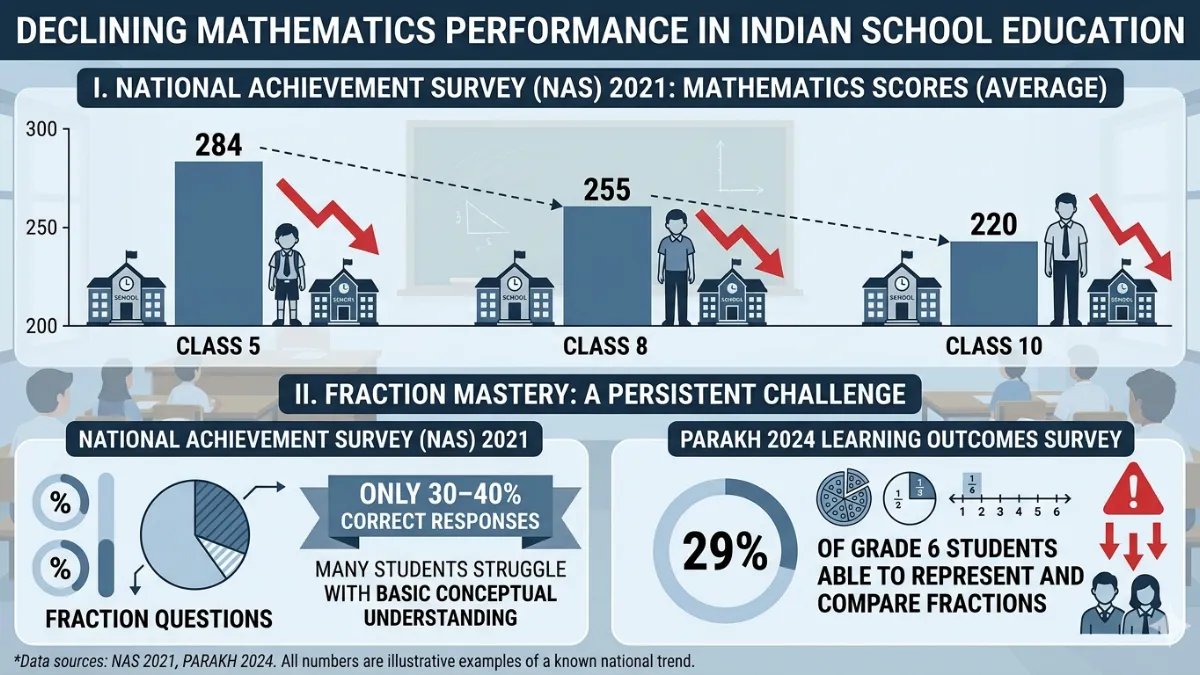
Bar chart infographic showing declining Indian mathematics scores: Class 5 (NAS 2021: 284), Class 8 (255), Class 10 (220), along with low fraction mastery (30-40% NAS 2021, 29% PARAKH 2024)
More importantly, NAS 2021 contained clear warning signs at the learning outcome level. Questions mapped to fraction-related competencies often saw only 30 to 40 percent correct responses. In practical terms, this meant that nearly 60 to 70 percent of students had not mastered foundational fraction concepts.
The system already knew where learning was breaking.
PARAKH 2024 does not introduce a new problem; it makes the same problem impossible to ignore. At Grade 6, only 29 percent of students were able to represent and compare fractions effectively. Nearly 7 out of 10 students lacked mastery over one of the most foundational concepts in mathematics.
The consequences are cumulative.
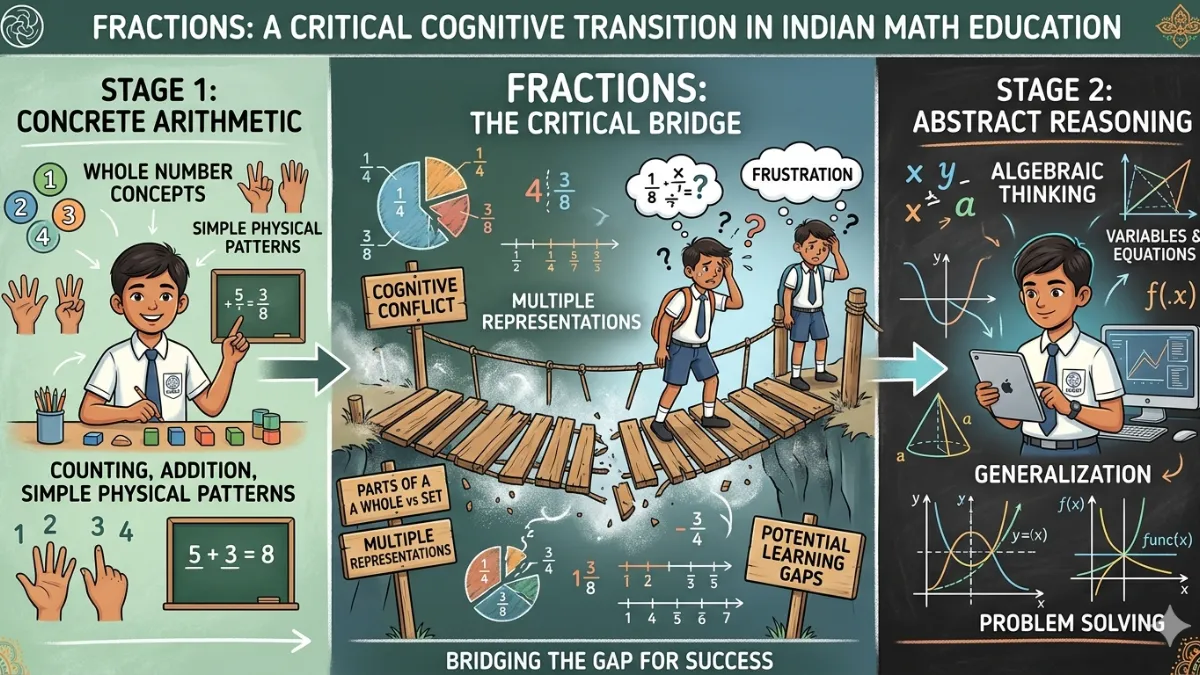
Educational infographic showing fractions as a bridge between concrete arithmetic and abstract reasoning, with a weak or broken bridge causing learning gaps in Indian mathematics education
A child who does not fully understand fractions in Grade 5 or 6 is likely to struggle with algebra in Grade 8, data interpretation in Grade 9, and advanced mathematics in secondary school. Over time, the issue is no longer about fractions alone; it becomes an inability to engage with abstraction itself. What eventually appears as weak Class 10 mathematics performance is often not a secondary stage failure at all. It is the delayed visibility of an unresolved conceptual gap from years earlier.
This is why the idea of Cascading Cognitive Deficit is so important. It shifts the conversation from broad averages to critical transition points in learning. It recognises that educational decline is rarely sudden. It accumulates silently, layer by layer, until the system can no longer conceal it.
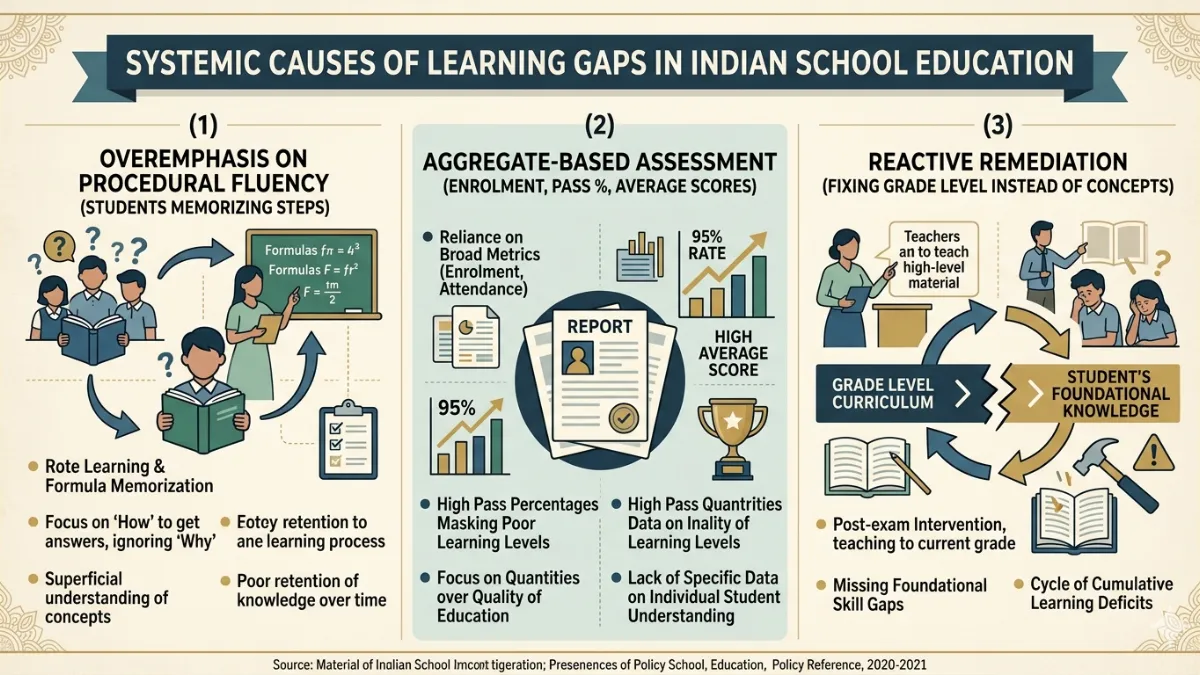
Infographic explaining causes of learning gaps in Indian schools: focus on procedural learning, reliance on aggregate assessments, and reactive remediation instead of conceptual understanding
The Indian school system’s engagement with CCD is not incidental; it is systemic.
- One reason lies in the historical overemphasis on procedural fluency. Teaching learning processes often prioritise arriving at the correct answer over understanding the underlying concept. Students learn to perform operations mechanically without necessarily understanding why those operations work. As long as answers appear correct, the system assumes comprehension exists.
- A second challenge lies in how success is measured. Education governance in India has historically focused on inputs and aggregates, enrolment rates, infrastructure coverage, pass percentages, and average scores. While these indicators matter, they do not reveal whether children actually understand specific concepts. Without granular competency level diagnostics, early warning signals remain hidden.
- Third, remediation systems are frequently reactive and non-sequential. Interventions tend to focus on grade level completion rather than rebuilding conceptual foundations. Students are expected to solve higher order problems without mastering prerequisite understanding. The deficit has already spread across multiple domains by the time remediation begins, making recovery significantly harder.
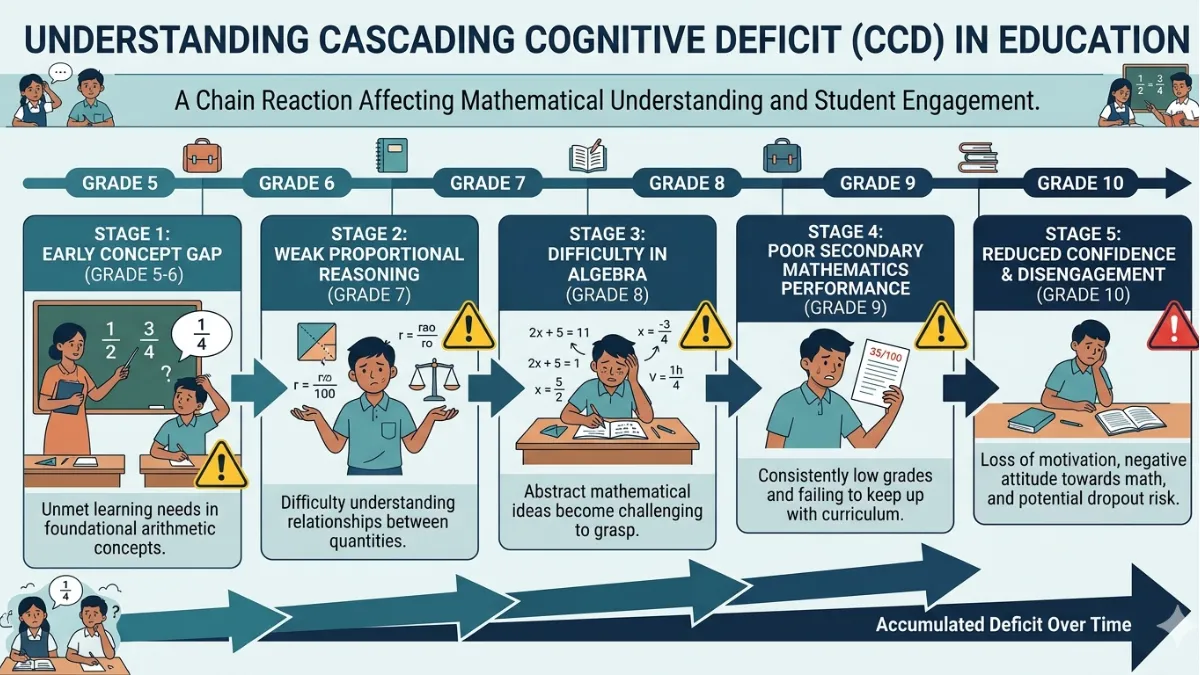
Systems diagram showing Cascading Cognitive Deficit (CCD) in education: a chain from early gaps in fractions to weak proportional reasoning, difficulty in algebra, poor secondary mathematics performance, and reduced confidence and disengagement, progressing from Grade 5 to Grade 10 over time
There also remains a persistent disconnect between assessment and classroom action. India has invested heavily in generating learning data, but far less in ensuring that this data meaningfully informs pedagogy. In effect, the system measures learning but does not consistently govern it.
Understanding CCD, therefore, reframes the problem entirely. It shifts the focus from improving overall scores to identifying and strengthening critical cognitive checkpoints. Fractions in this context are not just a topic in the syllabus; they are a diagnostic lens into the health of the learning system itself.
Addressing this challenge requires a structural shift in educational governance.
- First, the unit of measurement must change from aggregate scores to mastery of specific competencies and learning outcomes. Knowing that a student scored 45 percent in mathematics is far less useful than knowing they cannot compare fractions or interpret proportions.
- Second, certain concepts must be treated as non-negotiable checkpoints in the learning journey. Just as foundational literacy has rightly become a national priority, foundational numeracy, particularly conceptual understanding at transition stages, must receive equal attention.
- Third, the education system must move from prioritising grade transition to prioritising competency transition. A student may transition from Grade 5 to Grade 6 without understanding fractions, from Grade 8 to Grade 9 without proportional reasoning, and eventually into secondary education carrying unresolved conceptual deficits accumulated over the years. The grade changes, but the competency gap remains. This is precisely where Cascading Cognitive Deficit takes root.
- The focus of the system, therefore, must shift from asking whether the child has completed the grade to asking whether the child has mastered the competency required for the next cognitive stage of learning.
- Competency transition would require the system to treat critical cognitive thresholds not merely as syllabus units but as developmental gateways that prepare students for the demands of higher-order thinking.
- Fourth, teaching approaches must move beyond procedural instruction toward conceptual scaffolding. Learners need visual, contextual, and experiential approaches that help them internalise mathematical relationships rather than memorise operations.
- Fifth, assessment must be linked to action through continuous feedback loops. Data should not end at reporting. It must inform classroom instruction, trigger targeted remediation, guide teacher support, and shape district-level planning in real time.
- Sixth, remediation itself must become sequential and foundational. The system cannot expect an application without first rebuilding understanding. Teachers are central to this effort, but they can only succeed if they are equipped with timely evidence, targeted support, and practical pedagogical tools aligned to actual student needs.
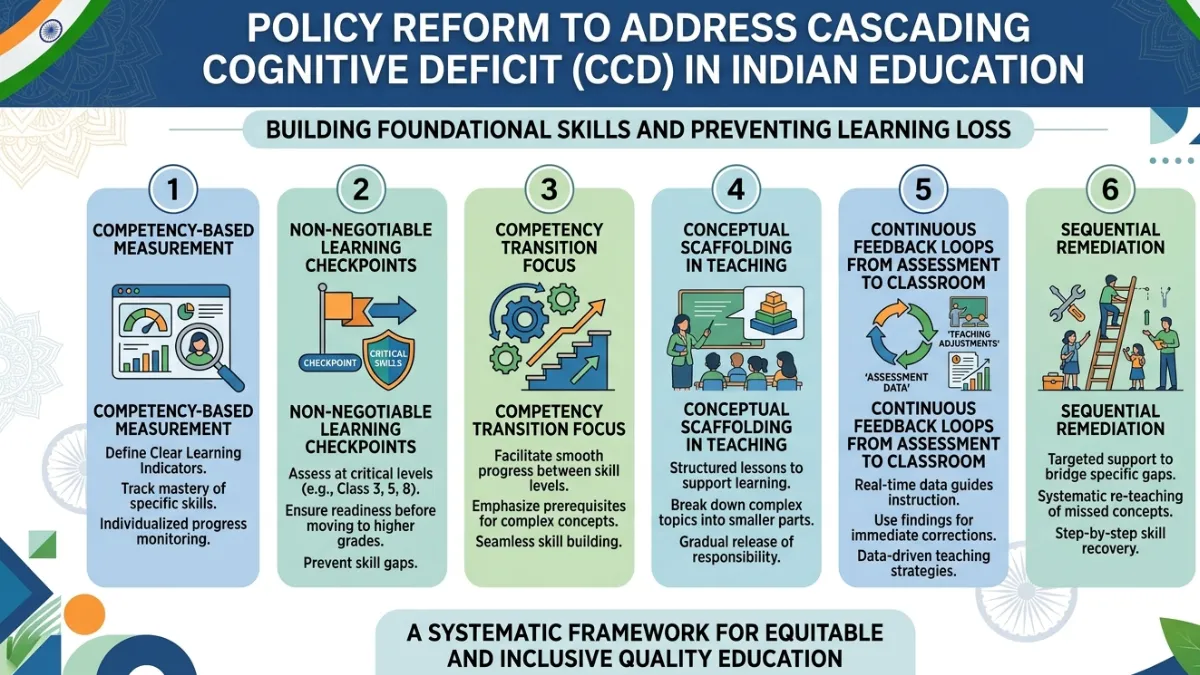
Policy infographic showing six reforms to address Cascading Cognitive Deficit (CCD): competency-based measurement, learning checkpoints, competency transitions, conceptual scaffolding, feedback loops, and sequential remediation
Under an NPST aligned approach, teachers need the ability to diagnose where learners are breaking conceptually, particularly at critical competency transition points. They must be supported to design scaffolded learning experiences that rebuild understanding before expecting application. Data must not remain confined to reports and dashboards; it must travel into classrooms through teachers who can interpret and act on it meaningfully.
India’s education system stands at a moment where such a shift is both possible and necessary. With the emergence of competency-based frameworks and data-driven platforms, the tools to address CCD are increasingly within reach. The challenge is to align system design with how learning actually unfolds, non-linearly, cumulatively, and with critical thresholds.
The tryst with Cascading Cognitive Deficit is not a failure of intent but a gap in alignment between pedagogy, assessment, and cognitive development. Recognizing it is the first step. Designing for it is the next step. The challenge is more fundamental: can it govern learning itself?
Have something to say?
Share your ideas, stories, or opinions with other students.